
Brittany’s food is shaped by the sea, the fields and a long history of feeding fishermen and farmers. While France is known globally for its culinary prestige, Brittany’s traditions feel distinct – simpler, heartier and deeply regional.
Much of the cuisine comes from what is readily available: seafood from the Atlantic, buckwheat from the fields, pork from small farms. Many traditional dishes were practical meals designed to sustain long days at sea or in the countryside.
Here are five Breton specialities that define the region – dishes you can try on your next visit, or attempt at home.
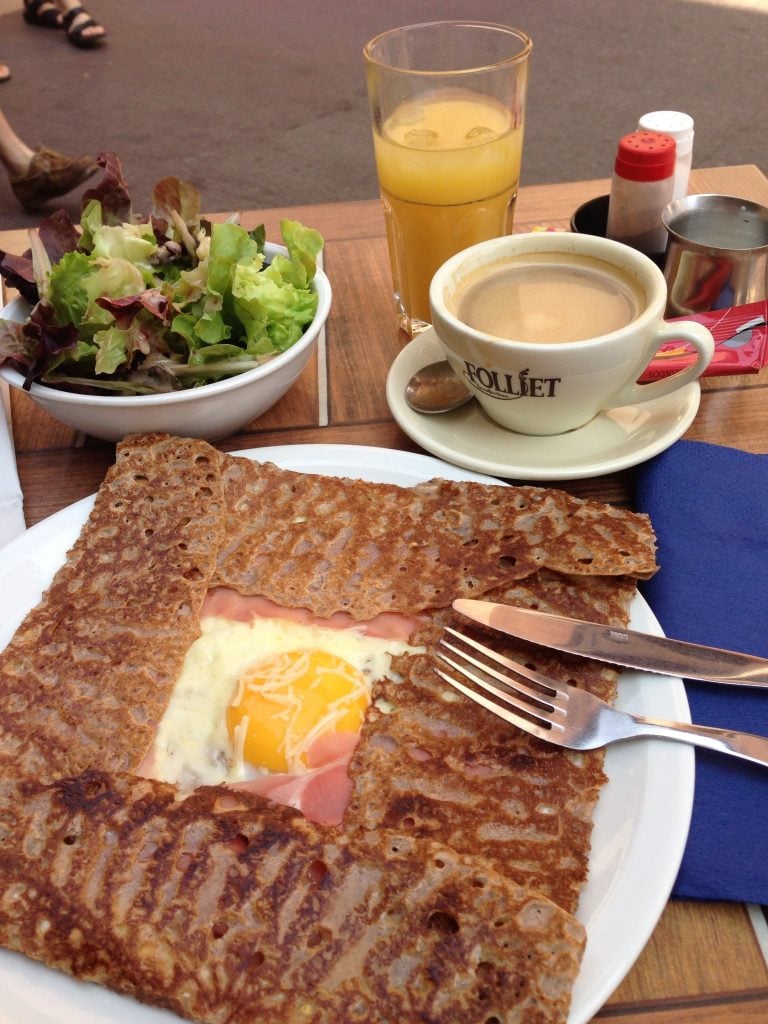
Galette
Crêpes originated in Brittany in the 13th century. Legend has it that a Breton housewife accidentally spilled porridge onto a hot stone and, rather than waste it, ate the result. Whether true or not, buckwheat crêpes – known as galettes – became a regional staple.
Unlike sweet wheat crêpes, galettes are savoury and made with buckwheat flour. They are endlessly versatile, filled with cheese, eggs, vegetables, meat or seafood. Buckwheat is also naturally gluten-free.
If you want to order like a local, ask for a galette complète: ham, Emmental cheese and an egg, folded neatly into a square with the yolk visible in the centre.
If you would like to make them yourself, try a traditional Breton recipe at home.
Galette Saucisse
Another way to eat a galette is as a galette saucisse – Brittany’s most iconic street food. This is essentially the Breton version of a hotdog.
A grilled sausage wrapped in a buckwheat crêpe, served in a napkin and eaten by hand. You’ll find them at markets, festivals and outside football matches. Onions are acceptable. Ketchup and mustard are not.
Simple, filling and unmistakably Breton.
Voir cette publication sur Instagram
Kig-ha-farz
Few dishes are as ingrained in Breton identity as kig-ha-farz, a name used only in Breton. It translates literally as “meat and stuffing.”
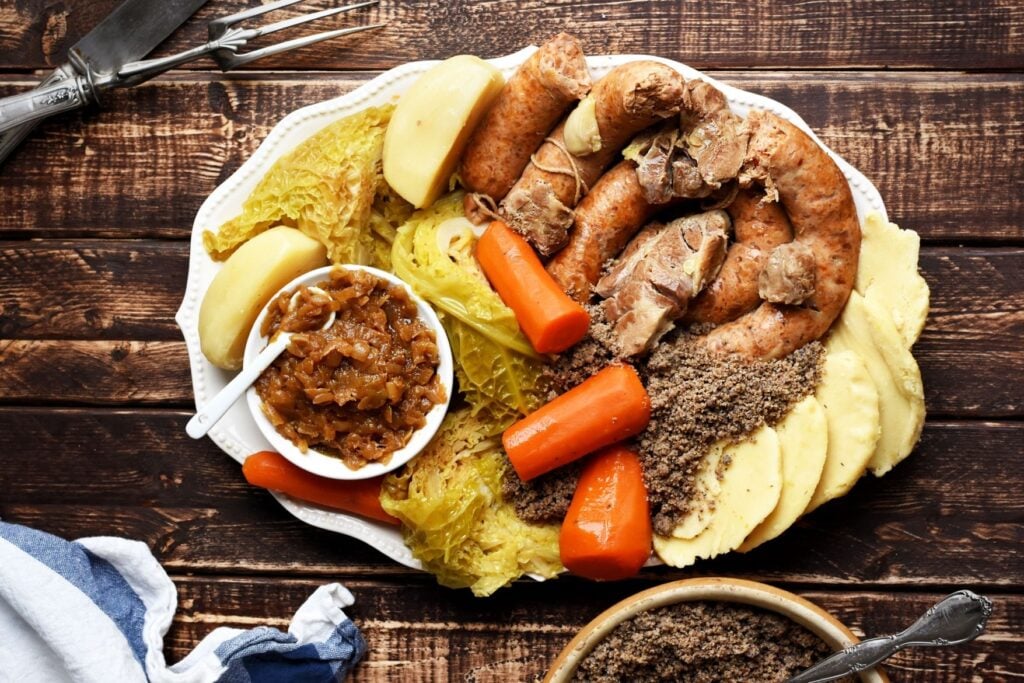
The dish is a slow-cooked stew of pork, beef and bacon with carrots, cabbage, leeks and onions. What makes it distinctive is the farz – a buckwheat-based mixture of flour, eggs and milk sealed in a cloth bag and cooked in the same pot. Once firm, it is sliced or crumbled and served alongside the meat and vegetables.
It is a practical dish, Bretons could leave it to stew for hours while they worked in the fields or waited for the fishermen to come back to port. Most recipes advise leaving it for 2-3 hours.
Although emblematic of Brittany, it is not always easy to find in restaurants. Look for a traditional Breton auberge if you want to experience it prepared properly.
If you would like to try making it yourself, seek out a recipe from a Breton source.
Moules frites
Along Brittany’s coast, fresh mussels define seaside dining – plucked daily from tidal ropes and served with crisp fries and local herbs.
The classic marinière combines white wine, shallots, parsley and butter. Other common variations include moules à la crème (with cream) or moules à l’ail (with garlic).
While often associated with Belgium, Brittany produces its own prized variety: moules de bouchot. Farmed in the bays of Mont-Saint-Michel and Saint-Brieuc, they are grown on wooden poles in tidal waters. The result is a mussel that is clean, firm and full-flavoured.
Cancale Oysters
In Cancale – a fishing village on the Bay of Mont-Saint-Michel – oysters are a rite of passage.. They were served at the court of Louis XIV and remain one of Brittany’s most celebrated delicacies. Head to the oyster market and try them fresh with a squeeze of lemon. Once you’ve eaten your fill, throw the shells onto the beach below the market for good luck.
The French for oysters is Les huîtres. Huître is pronounced exactly like the number eight in French, huit.
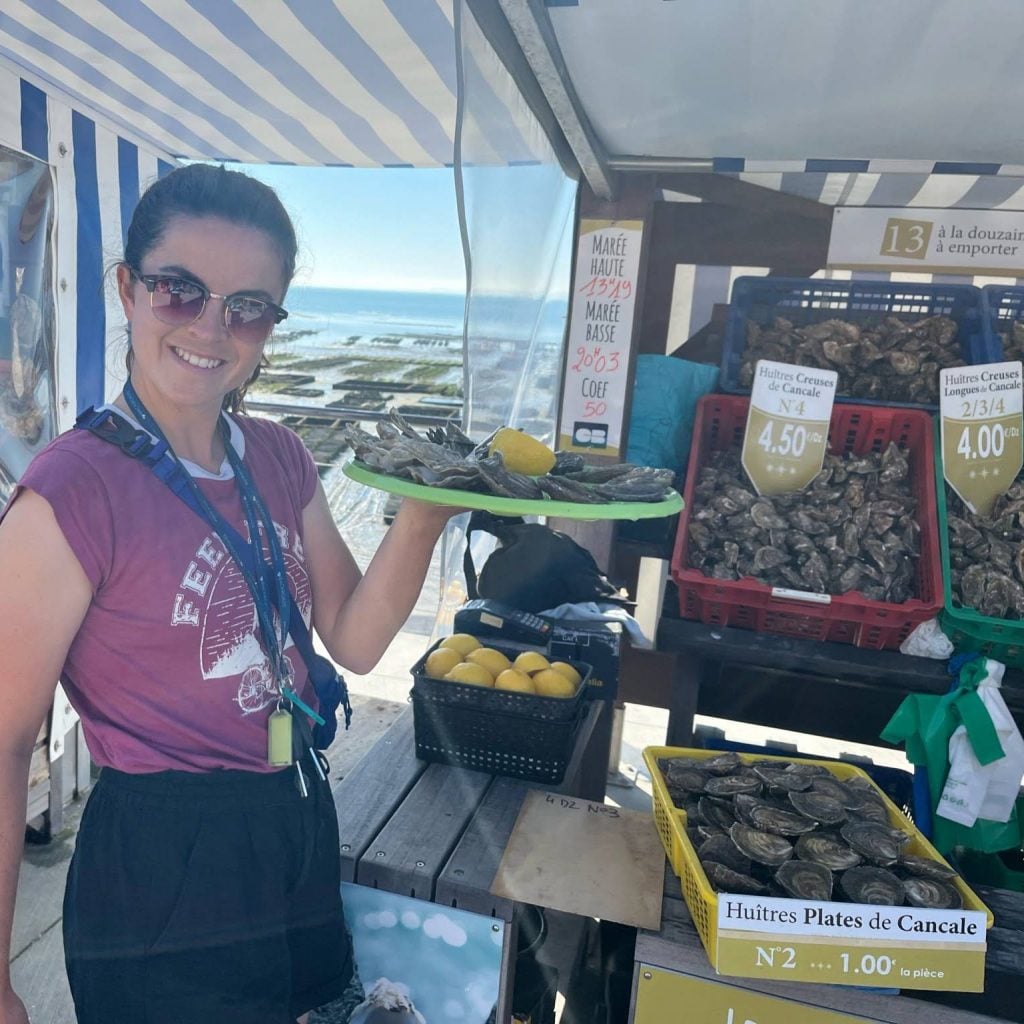
There are two main varieties: huître plate (flat) and huître creuse (round). The flat oyster is the native species and the one historically sent to Versailles. In the 1970s, a parasite nearly wiped out the local population, leading to the introduction of Pacific oysters from Japan. Thanks to the nutrient-rich waters of the bay, oyster farming recovered and continues to thrive.
Oysters can be eaten year-round, but they are traditionally considered at their best between September and April – any month containing the letter “r.”
Cotriade
In a region defined by fishing, it is no surprise that Brittany has its own traditional fish soup. Cotriade is often compared to Marseille’s bouillabaisse or the Basque ttoro, though it remains distinctly Breton.
The name comes from the Breton kaoteriad, meaning “the contents of a pot.” Traditionally made from the portion of the catch allocated to sailors or from unsold fish, it evolved into a regional speciality built on freshness rather than leftovers.
A cotriade typically includes a variety of local fish and shellfish — hake, red mullet, sardines, conger eel, mussels, cockles or langoustines — cooked with white wine, herbs, leeks, carrots, onions and potatoes. The order in which the fish are added matters, ensuring each variety is cooked correctly.
Served simply, often with a drizzle of oil and chopped herbs, it reflects the abundance of the Breton coast.
If you would like to recreate it at home, use the freshest local fish available to you.
“Magit mat ho korf, hoc’h ene a chomo pelloc’h e-barzh.”
Breton Proverb
“Nourish your body well, and your soul will remain with you longer.“
There are many reasons to visit Brittany, but its food remains one of the most revealing. These dishes tell the story of a region shaped by sea, soil and self-sufficiency and this is only the savoury beginning.