
You arrive in France. At the boulangerie, two friends greet each other with a kiss on both cheeks. Later, in a local bar, each new arrival works their way around the room, repeating the ritual. At some point, someone turns to you. A warm bonjour, two quick cheek kisses and they move on.
This is la bise.
For many visitors, especially from more reserved greeting cultures, it can feel unexpectedly intimate. In other cultures, you only kiss close family members like when your grandma plants a big sloppy one on your cheek. In France, however, it is neither romantic nor intrusive. It is a standard social gesture that signals politeness, inclusion, and familiarity.
Understanding when and how it happens makes everyday interactions in France far more comfortable.
What is La Bise?
La bise is a cheek-kissing greeting used among friends, family, colleagues, and in some settings acquaintances.
France is often described as a contact culture. Physical greetings are normal and expected within social circles. Unlike a handshake, la bise signals warmth and social ease. Unlike a romantic kiss, it carries no romantic intent.
It is simply how many people say hello and goodbye.
The Language of Kissing
French distinguishes clearly between social kissing and romantic kissing. The vocabulary matters.
Un bisou – A general word for “a kiss.”
- Donner un bisou — to give a kiss
- Faire un bisou — to give a (small, affectionate) kiss
Used with children, friends, or affectionately in messages.
Faire la bise – The act of greeting someone with cheek kisses. This refers specifically to the social ritual – not romance.
S’embrasser – To kiss romantically.
Example: Ils se sont embrassés — They kissed.
Baiser – As a noun (un baiser), it can mean “a kiss” in formal or literary contexts. As a verb, however, it is vulgar slang for sex. This is not a word to experiment with casually.
French kiss – The English expression does not exist in French. A deep romantic kiss might be described as un baiser profond. The English phrase reflects Anglo associations with French sensuality rather than French usage.
How many kisses?
Depending on where you are in France the norm will vary from one to four kisses, though two is by far the most common.
If unsure, follow the other person’s lead. Lean in and mirror their movement. The ritual is more choreography than affection.
No one really knows the significance of kissing more or less than twice. Regional variations are a cultural habit, there is no secret message or meaning in the number.
When to kiss strangers?
You are not expected to kiss every stranger you pass.
A simple bonjour is sufficient in shops, on the street, or in everyday transactions. In fact, failing to say bonjour is considered far more impolite than avoiding la bise.
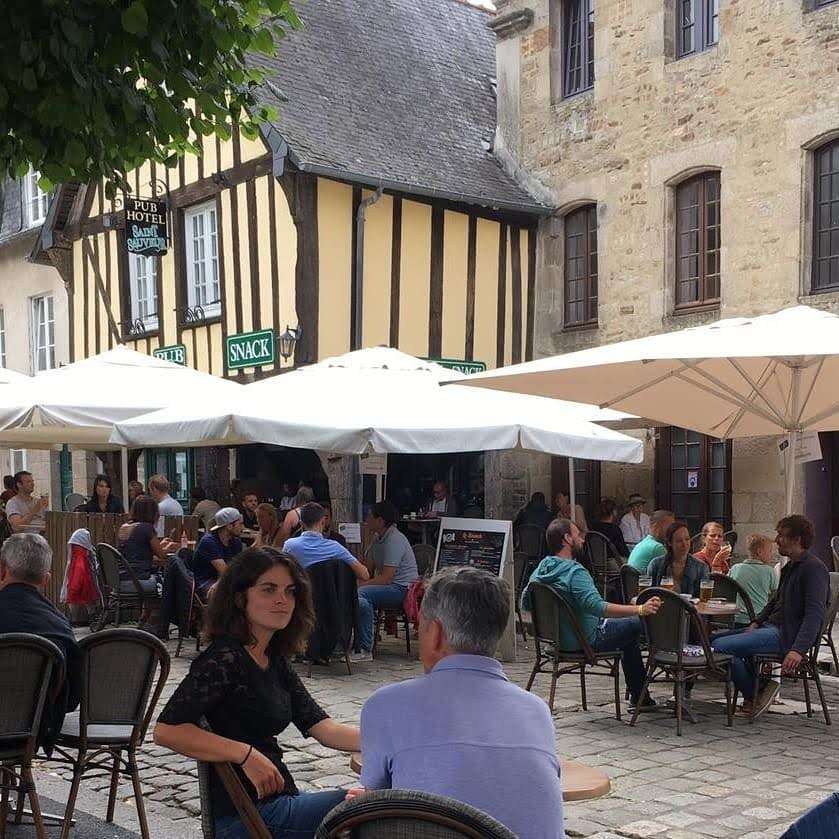
In my experience, I was first caught off guard in a bar in a small town in Brittany. As it was a local bar and most people know each other, the assumption is that almost everyone is a local. In this case, a friendly local bar setting, it might be impolite not to faire la bise upon entering. I was greeted by a man I didn’t recognise with la bise and then I turned to my husband and asked who that was. He shrugged and said, “I’ve never seen him before.”
You are likely to encounter la bise in:
- Family gatherings
- Dinners at someone’s home
- Among close friends
- Small-town or village social settings
- Some office environments (observe first)
In recent years men will kiss other men but this is mostly reserved for close friends and family. As a woman you are much more likely to faire la bise with everyone. It is not seen as sexist as it would be rude not to greet a woman in this way.
You are most likely to experience this greeting if you are invited to dinner at a French family’s house. There you will be expected to faire la bise upon arrival – you have to kiss everyone before you can sit down for dinner. And then again when you are saying goodbye at the end of the night. This can be quite a long process if lots of guests arrive one after the other!
How to kiss strangers?
I have been talking a lot about ‘kissing stangers’. Despite appearances, cheeks often barely touch. There is no real kissing involved.
The movement is simple:
- Lean in;
- Light cheek contact (or near contact).
- Make a soft kissing sound.
- Switch sides.
- Repeat.
You are brushing past faces, not planting kisses. If you are uncomfortable, minimal contact and the correct motion is perfectly acceptable. It is the intention that matters here.
In Larger Cities
In Paris and other major cities, especially in tourist areas, you are unlikely to be greeted this way by strangers. The practice is strongest within established social circles and smaller communities.
When it does happen, it is not flirtation. It is not forwardness. Nor is it a test.
It is simply good manners.