
Saint-Malo is a town shaped by tide and conflict. A fortified city whose walls hold stories of corsairs, explorers and fire. Not only is it pretty with sandy beaches and a fortified old town, but Saint-Malo also tells many stories. Rich in history because of its location, in this article I’m going to delve into some of those tales of exploration, discovery, destruction and renovation.
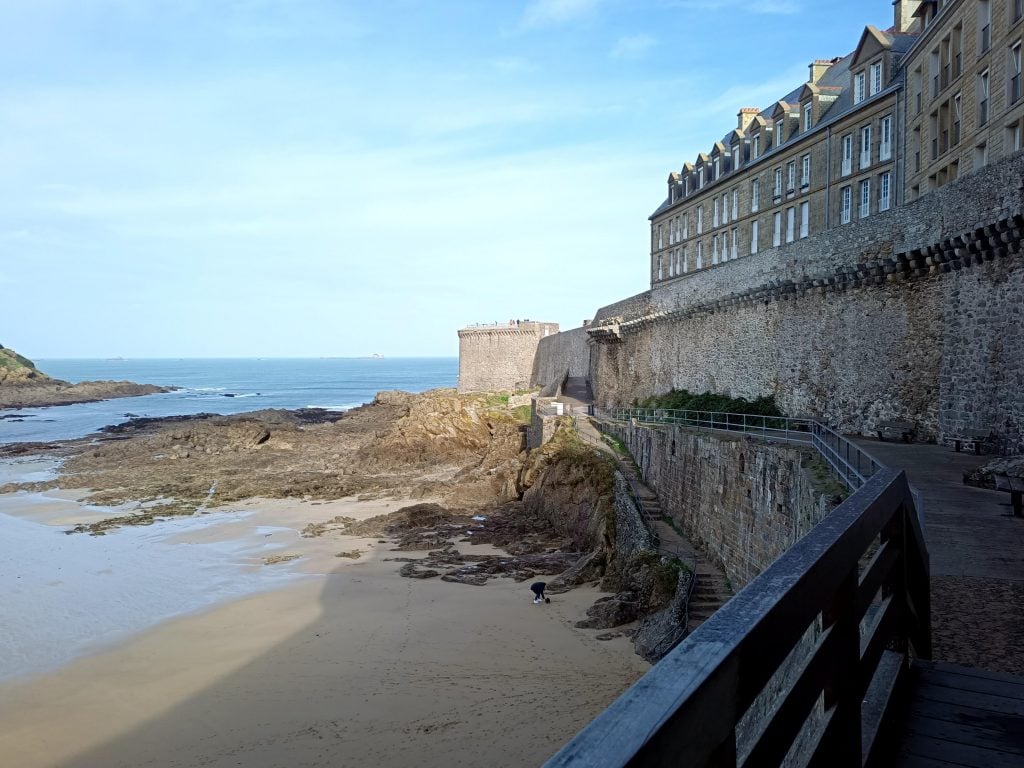

Walk the ramparts today and you’ll see their statues watching the sea. Reminders that this town once fought, traded and gambled its fortune on the horizon.
Departing Saint-Malo for Canada
Jacques Cartier
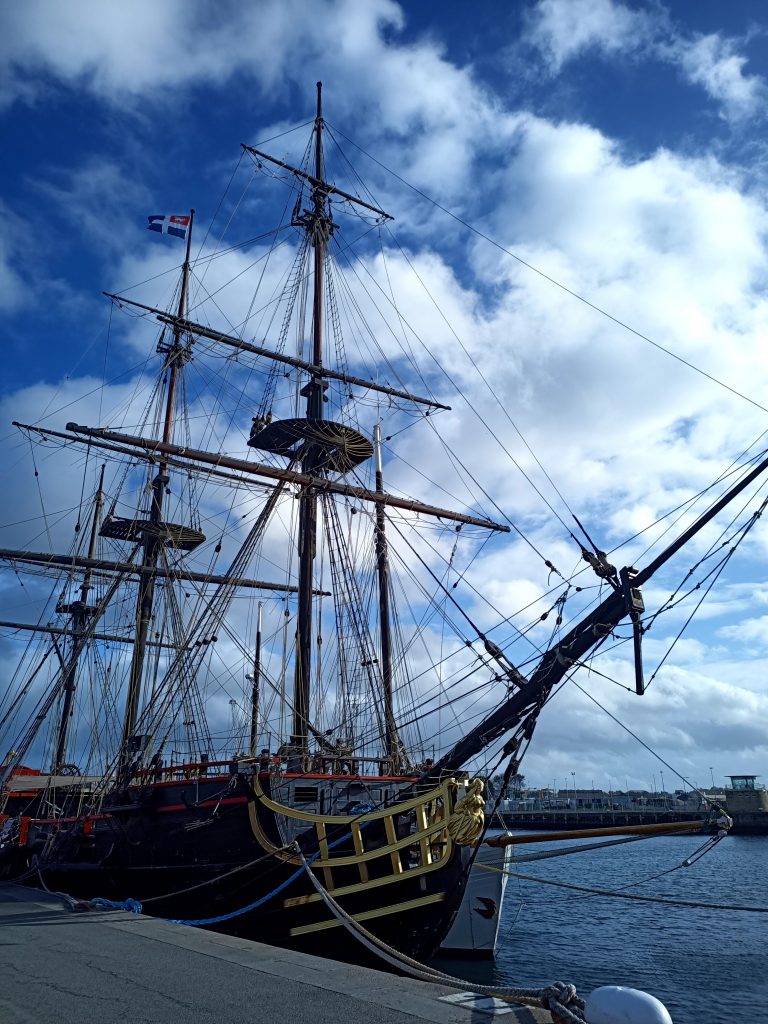
Saint-Malo was also the birthplace and departure point of Jacques Cartier, who sailed west in 1534 in search of a route to Asia. Instead, he charted the Gulf of St Lawrence and laid the foundations of France’s presence in Canada.
He left the harbour with two ships and sixty-one men, crossing the Atlantic to Newfoundland in twenty days. Looking for a passage to Asia they continued around the west coast of Newfoundland and the Gaspé Peninsula. Although they didn’t find a passage to india, they did bump into Mi’kmaq communities trading furs.

On his second Atlantic voyage, Cartier discovered what is now Quebec. The word “Kanata,” used by indigenous guides to describe a settlement, would later give Canada its name.
Yet Cartier was not the first Breton to cross the sea. Fishermen rom the north coast of Brittany had likely reached Newfoundland decades before Cartier, drawn by rich cod stocks. Some settled seasonally, forming early francophone communities long before colonisation was formalised.
The Allies crossed into France via the Normandy beaches on D-Day, 6 June 1944. By August, they had pushed into Brittany with the goal of capturing Saint-Malo and turning its port into a supply hub. Designated as a fortress under the German Atlantic Wall program, this was not going to be an easy battle for the allies.
Bombing began on the 6th of August and one of the first casualties was the cathedral’s spire. By the time the battle ended, 80% of the intra-muros lay in ruins.
380 men from Saint-Malo were imprisoned by the Germans in the Fort National for the duration of the battle. The Fort sits across from the walled city and is accessible at low tide.
An eye witness account:
“The sky was dark because of the smoke, and pieces of burnt paper flew from the city and towards the Fort National. St Malo became a raging inferno; we stayed there to look at the fire burning the walls of one of the most charming cities of the world. In only few days, the fire destroyed the work of several generations under our stunned eyes.”
Joseph Baladre, held at Fort National during the battle.
Despite the devastation, the people of Saint-Malo chose restoration over reinvention. Rather than flatten the ruins and build anew, they painstakingly reconstructed the city stone by stone. Between 1947 and 1972, the walled town rose again, faithful in appearance, yet entirely rebuilt.


Today, as tides sweep dramatically in and out beyond the walls, it is hard to imagine the inferno that once consumed the city. Yet Saint-Malo has always lived between destruction and renewal. Its walls are not just stone; they are memory, resilience, and a reminder that this corner of Brittany has never been passive in the face of history.
Explore Saint-Malo on Foot
Planning a visit? Follow my suggested walking route through the ramparts, beaches and the neighbourhood of Saint-Servan with this downloadable guide.
View the Saint-Malo Walking Guide